ARTIST STATEMENT
Jelena Fužinato works across drawing, painting, spatial installation, and participatory practice.
Negotiation sits at the centre of her work, as both method and subject, probing how rules, laws, and power structures produce social norms, and how artistic practice can challenge and reshape them.
Her approach is autoethnographic: personal experience becomes a lens through which broader questions of transnational politics, colonial continuities, and institutional exclusion come into focus. Drawing on decolonial thought, she treats the self not as a stable origin point but as a site of contested meanings, shaped by borders, migrations, and the uneven geographies of knowledge production. Personal history is never simply personal; it is always already entangled with larger structures of power.
At the core of her practice is a understanding of how individuals make sense of the world. Fužinato is interested in how people build and rebuild their systems of meaning under conditions of constraint, how power does not only operate through institutions and laws, but penetrates the psyche, structuring what feels possible, thinkable, or sayable. Her work creates conditions in which those constructs can be tested, loosened, and renegotiated collectively.
Her work is a permanent Bauštele. The word is borrowed deliberately from German, a construction site, always incomplete, always under revision. Rooted in her family history of construction workers and her own trajectory across the uneven institutional landscapes of Europe, the Baustelle becomes a gesture: a refusal of the finished, the authoritative, and the settled. It holds open the question of who gets to build, and on whose terms.
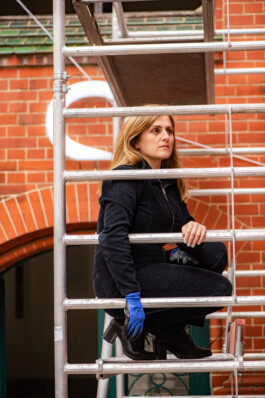
Fužinato, Jelena, The Builders Daughter, Iterration I, 2022, Kunst Raum Mitte, photo: Yero Adugna Eticha